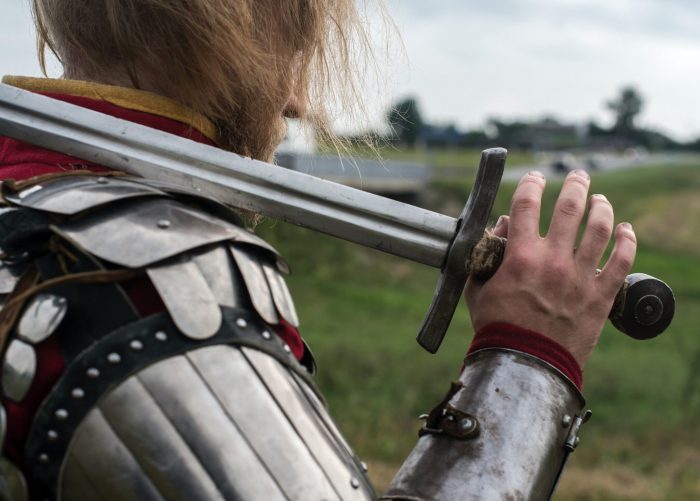
One of the awesome things about Historical European Martial Arts is that they come from a rich historical tradition. And this tradition includes a wealth of instructional books written from within the period where those arts were most actively practiced.
Picking up a 15th-century fighting manual is by no means necessary to learn, practice, and enjoy these martial arts, but doing so can offer a significant richness to that practice. In our school, we require anyone who wishes to challenge for our Scholar rank (the second rank) to read the introductory sections of either the rapier manual of Ridolfo Capo Ferro (1610) or the medieval martial arts manual of Fiore dei Liberi (1409). The goal is simply to understand the roots of our tradition and to peak into the scholarship that has been undergone by many to revive these arts from the past.
As you progress along this journey there may then come a time when you want to dive into the scholarship side of these martial arts and take your own crack at decoding and understanding how these historical masters practiced and taught their arts. This can be a great way to deepen your own understanding and technical ability or can simply be a great way to indulge in history or come up with some challenging questions for your teachers.
The approach I detail here is for those whose goal is to develop a deep understanding of the art represented in a particular manual. There’s definitely value in more cursory readings but when you want to really “eat the book” I recommend this process.
Read It Cover to Cover Without Interpretation
I think one of the easiest mistakes when working with a historical source is to think of it as a modern technical manual. Something designed to be read and followed page by page with each page building on the last.
This is not generally the case. Many historical authors assume a lot of precursor knowledge on the part of their readers. There is an expectation that you’ve been practicing martial arts since a young age, and what they’re revealing to you in their manual is their particular secrets or approaches to something in which you already have a grounding. This means they are typically not “starting at the beginning”. Even those who seek to start from first principles, the art of technical writing developed significantly in the industrial era where the emphasis on entertaining reading was de-emphasized in favour of consistency and comprehensibility.
If you want to build a knowledge of a historical author’s system, I recommend you first quickly read it from cover to cover. Not with the goal of thoroughly absorbing or memorizing it, but with the goal of understanding their overall concepts, the flow of the text, and the shape of their approach.
Many historical authors present their “first principles” later in their texts or scattered throughout. This quick read will help you collect at least a few of those for when you begin a more thorough study.
Touch Every Technique
One of my favourite things to do on my next pass is to put on a one- or two-minute interval timer and build a quick and dirty interpretation of every technique in the manual (or a section of the manual). Again my goal here is not rigour, it is exposure and to know the big picture. In the past I often found myself puzzling through a particular interpretation for hours upon hours trying to decode a vague phrase or decipher a particular diagram, only to then find out the same technique is repeated a few pages later in much greater detail.
Going through the manual with the goal of touching the techniques. in addition to your previous reading, can give you a very solid view of the overall text that will serve you when you move into more detailed interpretation.
Interpret
Now you get into the meat of the matter. Start at the beginning of the book (or the given section you want to rigorously study) and begin a more thorough study of the material, weapon in hand and partner nearby.
I recommend making a scheduled time in your week to work through the material section by section, action by action. I think it’s even worth spending some time on sections that are only describing principles—if you’ve already touched all the exemplar techniques in the book you may now be able to apply some of them to the more principle-centric passages.
Be sure to tap into the broader community to learn how others have already interpreted given techniques. Doing work on your own can be a useful challenge and can potentially give you unique insights, but research is greatly forwarded by standing on the shoulders of those who have come before you. Be critical but dismiss the idea that working completely independently is somehow better—there is no other field of research (that I know of) that takes this approach.
Memorize
Some medieval and renaissance texts are immense, and the idea of memorizing the whole book may be logistically impossible, however, there is great value in memorizing sections.
Take your current interpretation and begin memorizing the actions from it in order. I first took this approach with the Rapier manual of Ridolfo Capo Ferro and found that a whole new level of connections became apparent to me once I was no longer working only from the page. Taking the time to bring the whole text into my mind allowed me to infer and discover connections that I may never have discovered even with a giant piece of paper and a police detective style pin and string matrix.
Memorization is a very fun and useful process, it’s also a sword-nerd-tastic party trick if you can perform all of Fiore’s sword actions in sequence without looking at the book.
Repeat
I have been working with Capo Ferro and Fiore’s texts for two decades and I still get new insights from them when I re-read and re-interpret them. If you’re passionate about deepening your learning be sure to revisit the material you already know with an open mind.
You’ll also find that as you branch out into other texts and get exposure to the interpretive works of others that your own insights will grow and your own capacity to make new discoveries from old texts will increase.
A Final Disclaimer
Don’t let this rigorous process intimidate you into avoiding historical sources. Reading little bits, dabbling on plays, or approaching your study in a completely different fashion is valuable! Be sure to poke your nose into a historical martial arts book in whatever fashion you can make happen!
Good studying everyone!

About the Author
Devon Boorman
Founder & Director
Devon Boorman is the Co-Founder and Director of Academie Duello Centre for Swordplay, which has been active in Vancouver, Canada since 2004. Devon's expertise centres on the Italian swordplay tradition including the arts of the Renaissance Italian rapier, sidesword, and longsword, as well as knife and unarmed techniques.