Archery is one of humanity’s oldest skills and one of its most adaptable. What began as a way to eat and survive became a tool of empire, a symbol of identity, and today a beloved sport and mindful practice. Archaeological finds suggest bow-and-arrow technology appears tens of thousands of years ago in southern Africa. While the earliest bows themselves rarely survive, stone and bone points show impact patterns consistent with arrows.
Some of the best-preserved early bows come from Holmegaard Bog in Denmark (c. 7000 BC): sleek elm self bows with broad limbs and a narrow grip, remarkably similar to modern bows in performance.
As agriculture, cities, and states grew, archery moved from the hunt to the battlefield. The right bow, matched to terrain, climate, and tactics, could change the course of nations.
1) The Mongol Composite Bow (Steppe Empires) 1200–1400 CE
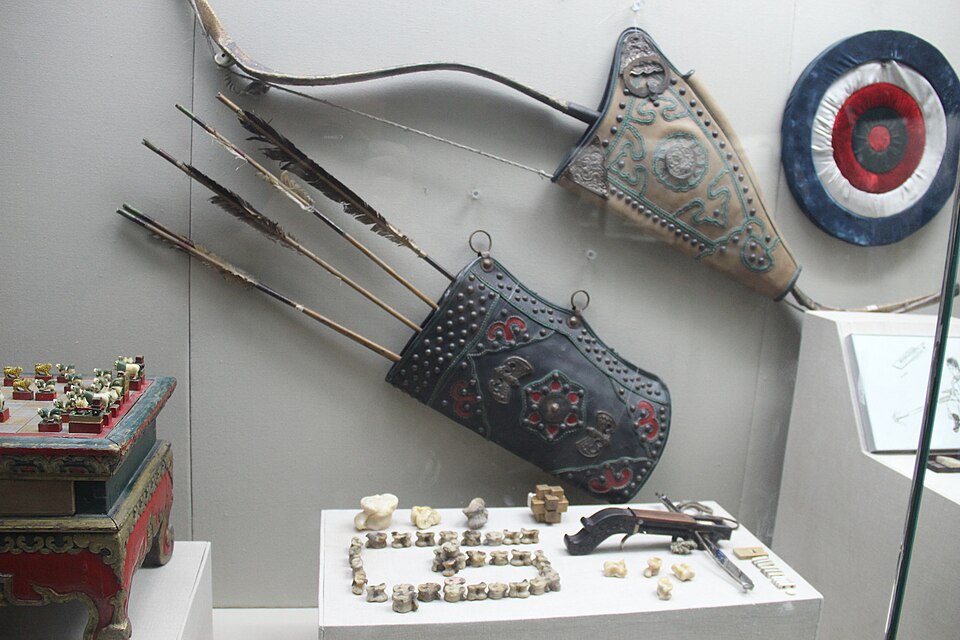
The Mongol composite bow was a marvel: a short, recurved core of wood sandwiched with horn on the belly and sinew on the back, glued with animal hide glues and sealed under bark or lacquer. That layering stored huge energy in a compact frame that worked in the cold, dry steppe. Riders commonly carried a bowcase and two quivers with various types of arrows for different jobs: arrows with heavy, narrow heads for armour; broader heads for unarmoured enemies and horses; whistling or signal arrows for coordination.
Mongol riders learned to shoot young. Small children practised from the ground, then from ponies at a walk, then at speed. By adulthood, the thumb draw (often with a horn or metal thumb ring) and a rock-steady torso made hit-and-run accuracy routine.
On campaign, commanders used feigned retreats and encirclements; the famous “turn in the saddle” shot kept distance while raining arrows. Rate of fire mattered: loose, wheel away, nock on the move, repeat. The composite bow let lighter, faster forces pick the fight, harry supply lines, break formation cohesion, and decide when (or whether) to close. Women also trained and competed in archery; steppe cultures kept the skill embedded in festivals and games, so proficiency stayed high between wars. The result was a system as much as a bow: material science, lifelong training, and tactical doctrine all tuned around a compact, devastating weapon.
2) The English/Welsh Longbow 1250–1460 CE
The longbow was as much a social institution as a weapon. In England and Wales, yeomen were expected to practise from youth, with village “butts” (earthen mounds) set aside for regular shooting. Market days and church holidays also doubled as archery time. That culture of constant practice produced archers capable of drawing bows near their own height. The longbow was a tall yew self bow in which pale sapwood (good in tension) and darker heartwood (good in compression) formed a natural composite. Draw weights were heavy by modern standards, and the training left its mark: period skeletons show enlarged stress features in shoulders and arms, the signature of thousands of repetitions. Equipment was organised at scale. Arrow makers, fletchers, and bowyers supplied armies with “cloth-yard” shafts tipped for different jobs: bodkins to seek joints and mail gaps, broader heads for unarmoured men and horses. Archers marched with sheaves of 24 arrows with additinoal wagonloads following close behind.
At Crécy, Poitiers, and Agincourt, archers were set forward or on the flanks behind rows of sharpened stakes laid out to protect from cavalry. The goal wasn’t only to kill: dense arrow storms forced men to raise their shields, tired men and mounts, shattered formations, and created openings for billmen and men-at-arms to finish the work.
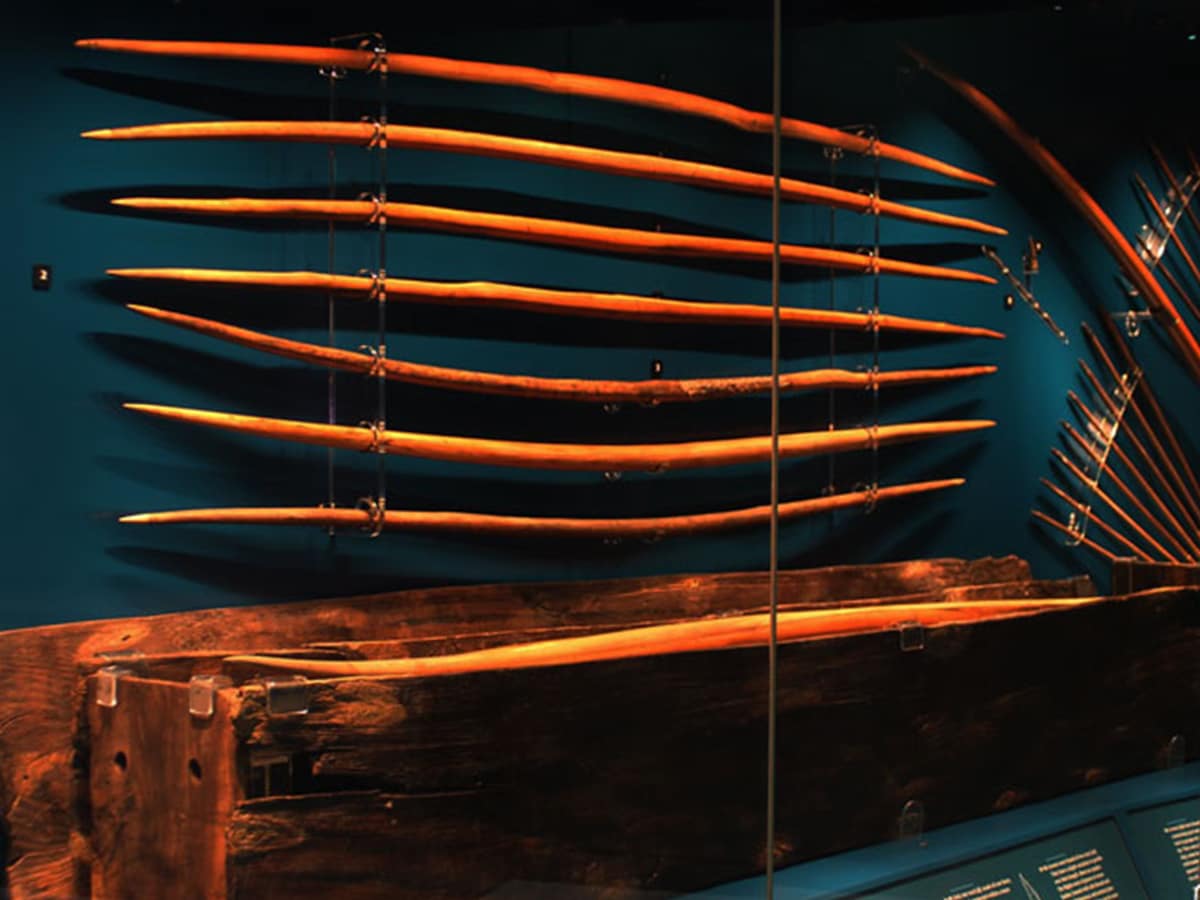
The Mary Rose cache later confirmed the war-bow reality. Hundreds of longbows and thousands of arrows stowed aboard this Tudor warship showed evidence of a state that planned its logistics around archery. Firearms eventually pushed the bow off the battlefield, but the longbow’s prestige endured through guilds and sport until the modern day.
3) Plains Indigenous Sinew-Backed Bows (North America) 1700–1875 CE
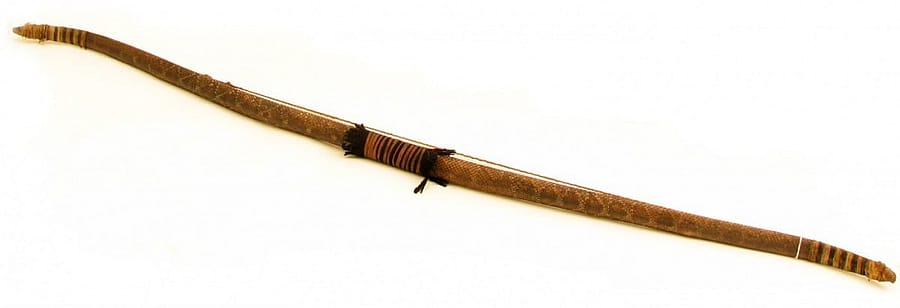
Short, quick, and perfectly adapted to mounted life, the Plains bow tells a story of environment and culture. After horses spread across the Plains, many Nations, such as the Lakota, Cheyenne, Crow, Blackfoot, and Comanche, favoured bows typically under four feet long. Makers selected resilient local woods (osage orange in southern regions, ash or chokecherry further north), then backed the stave with twisted animal sinew set in hide glue. When cured, that backing acted like a spring, adding snap and toughness to a compact limb, ideal for close-range power from a moving horse.
Arrows were tuned to purpose: heavy shafts for bison, lighter for small game or war; stone points gave way to trade-metal points after contact with Europeans. Equipment often travelled as a set: bow, bowcase, and quiver all carried from the saddle. Decoration, including quillwork, beadwork, paint, and trophy elements, were not just for ornamentation but were also used to mark achievements, identity, or spiritual ties. Archery training began early in family settings, with boys and, in some communities, girls practising with small bows for play, hunting, and later for warfare. On a buffalo run, the short bow’s advantages shone: it was easy to shoot from the back of a horse while allowing for quick draw and release with enough penetration for clean kills. In intertribal warfare, the same traits encouraged speed, surprise, and skill at very close distance. Beyond utility, the bow sat inside a broader world of ceremony, vision quests, and warrior societies.
From History to Practice in Vancouver
At Academie Duello, we teach archery as a martial art, not just a sport. Using recurve, longbow, flat bow, and ACB (Asiatic composite bow), you’ll connect with the rich martial history of archery. You’ll build posture, breath, and shot process while learning both Mediterranean and thumb releases, timed shooting, and tactical problem-solving. Start with traditional fundamentals in a welcoming, progression-based path, then advance through ranks in our Archery Mastery program—or bring a team for a 1–2-hour adventure that makes history hands-on and fun.
Getting Started
- Try a beginner session. Safe, supportive, and gear provided.
- Bring friends for a one-off adventure. Archery is low-barrier, high-engagement, and unforgettable.

About the Author
Devon Boorman
Founder & Director
Devon Boorman is the Co-Founder and Director of Academie Duello Centre for Swordplay, which has been active in Vancouver, Canada since 2004. Devon's expertise centres on the Italian swordplay tradition including the arts of the Renaissance Italian rapier, sidesword, and longsword, as well as knife and unarmed techniques.