This is the first in a series of posts that explore horsemanship as it was practiced by knights and other mounted warriors of the European tradition. We study many of these things as part of Knight Camp and the Mastery program at Academie Duello but if you want to get even more in-depth you can visit Academie Cavallo to take part in full mounted combat programs.
Today we are exploring the language of horse description.
Near and Off Side
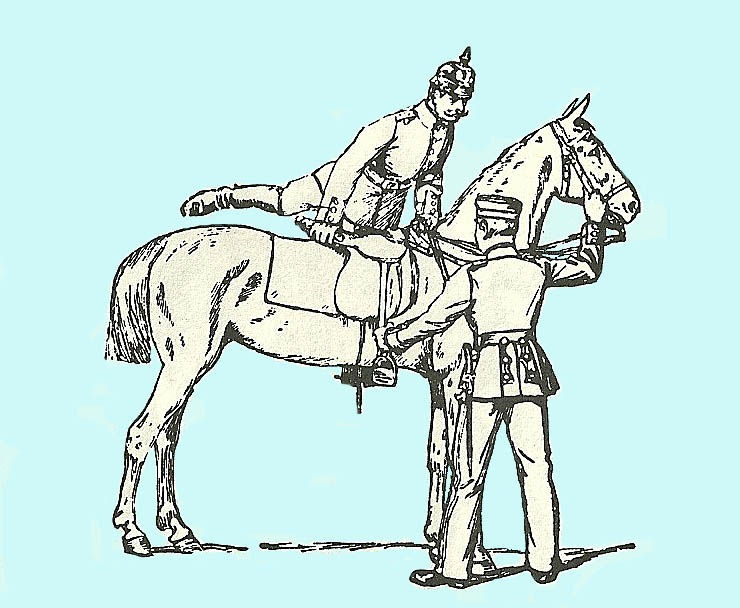
The horse’s left is his near side, the right his off side. We lead horses, do up their tack, and mount from the near side. Believe it or not, this all goes back to the days of wearing swords on horseback. Since a sword is usually hung from the left hip, mounting from the left means the scabbarded sword does not have to cross the horse’s back as the rider swings his leg over. Also, if you are mounting with sword in hand, your left hand is able to control the reins, and the right hand your sword, as you mount.
Colour
The only horse coat colours that have obvious names are black, brown and grey, and there are even subtleties within these. Fortunately there are plenty of websites and books with colour pictures to study, and the Wikipedia entry is quite comprehensive. For the purposes of level 1 you will need to know:
Bay: brown or reddish coat with black mane & tail
Chestnut: light brown or copper coat with matching (or flaxen) mane & tail
Grey: including variations such as dappled (circles of dark hair) or fleabitten (flecks of dark)
Piebald: large patches of black and white
Skewbald: large patches of another colour and white
Buckskin: gold or dun with black mane & tail
Palomino: gold with white mane & tail
Spotted (Appaloosa colouring): small spots of dark on white or white on dark
Roan (blue and red): an even mixture of dark and white hairs
Twenty Simple Parts of the Horse
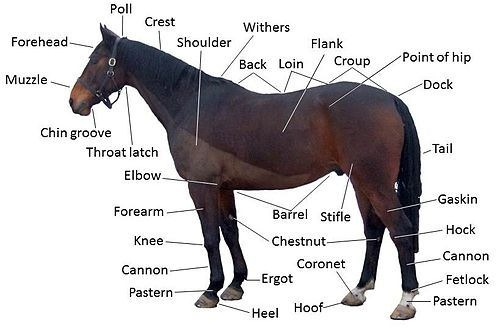
Again there are plenty of online references for this, or you can simply turn to the inside front cover of the Manual of Horsemanship. For level one you should know at least 20 of the following points:
Poll, ear, muzzle, crest, mane, neck, withers, shoulder, elbow, forearm, knee, cannon, fetlock joint, pastern, coronet band, hoof, back, barrel, loin, croup, dock, tail, stifle, gaskin, hock
Why do I need to know this?
While this type of knowledge may seem rather trivial or esoteric at first, it is actually quite important to be able to share the common language of horsemen. If you are asked to catch the chestnut mare and check her off hind pastern before tacking up, you’d better not come in from the field with the bay and be looking at her knees!
Going further
For higher levels of Horsemanship you will need to know face and leg markings, colour points, breeds, types, and conformation. The Manual of Horsemanship is a good starting point, and there is a wealth of information available online.

About the Author
Jennifer Landels
Mounted Combat Instructor
Jennifer Landels heads up Academie Duello's Cavaliere Program. She has been swordfighting since 2008, and riding since before she could walk. She started the program as an excuse to combine those passions.