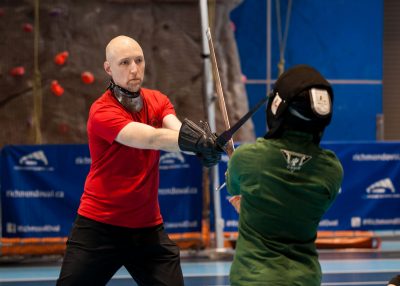
As discussed in my previous post on Stage Combat Trends, swordplay for the stage (and the mainly French terminology actors and stunt performers use) came initially from sport fencing. The first fight choreographers in film were fencing champions, and fencing was a part of most private schools and professional actor’s training.
The lineage looks like this:
- Rapier duelling (thrust) and sidesword-buckler (cut)
- Smallsword duelling and backsword/sabre duelling
- Foil fencing to practice duelling and singlestick or cudgel to practice sabre
- Sport fencing (epee, foil, sabre)
- Stage combat (modern)
(This is a simplification; I’m happy to discuss the nuances about this evolution, including the obvious fact that Shakespeare includes staged fights well before modern fencing existed. The lineage described here refers to today’s practice and especially teaching of stage combat using fencing terms and sabre positions.)
Stage combat evolved from fencing because the sport had largely replaced historical swordplay. There were a few select places like the Bartitsu Club (1898-1902) that explored old weapons and methods, but most actors only knew their fencing.
Once a fencer had gained familiarity with sport fencing, they might start exploring the historical manuals, but these books were often difficult to find or to order. Until recently, it was practical and necessary to assume that modern fencing was close enough to its roots to appropriately substitute for the genuine martial art. It also provided a unified vocabulary for almost every conceivable foot motion or sword movement, in French, that was shared throughout the world.
Disruption
Then came the Internet, and I believe we are experiencing a major turning point in our approach to stage combat. It just so happens to coincide with the near-disappearance of fencing from high schools, acting training and post-secondary education, except for specialty clubs. At the same time, the manuals written by fight masters from bygone centuries are being reprinted online and available to order from print-on-demand sites if you want a physical copy. The resurgence of Western Martial Arts at facilities such as Academie Duello are gaining popularity over sport fencing. For these reasons, fight choreographers have the opportunity to simulate combat in particular cultural context without resorting to fencing analogies.
There is no reason to start from sport fencing anymore. Private schools, actors, the military… nobody has fencing as a required course these days. Therefore, no new actors will be familiar with even the basic terminology of fencing.
Unless you’re simulating a fencing match, the only reason to continue to rely on sport fencing as a basis for stage combat is continuity with previous generations of instructors. If we want historical and emotional authenticity in our entertainment, fencing is a counter-productive way to start.
The Common Thread
The skill that crosses all cultural lines and weapon styles is the very thing that makes stage combat possible: the ability to perform any action so that the audience believes you have deadly intent while keeping your partner utterly safe. It’s what I call the illusion of violence.
The Illusion of Violence has three components:
- Safety: How are the fighters and the audience kept safe?
- Simulation: What movement will convince the audience that your motion is genuine in intent and effect?
- Storytelling: What qualities of stance, voice and style will convey character and plot?
In terms of safety, the actor must be trained in four techniques with any weapon (including unarmed):
- Distance: You are too far to touch your partner, and hide that distance from the audience
- Target: You are close enough to hit, but you practice controlled strikes toward safe targets, without slowing down or otherwise betraying the authenticity
- Timing: The use of cue-reaction-action procedure to produce believable evasions that are in-distance and on-target
- Cooperation: When partners are touching (push, pull, choke, etc.), the choreographed movement is led by the victim and uses “reverse energy” or shared balance.
My proposal for the New School of Stage Combat would teach actors:
- To learn the essential illusions from a stage-magic and film making perspective.
- Then learn some unarmed techniques to make instinctual moves look correct (slaps, chokes, hair pulls, wild punches, etc.)
- Then start learning historical combat and incorporating the illusions into choreography as you develop skill in particular attacks and defences.
At Academie Duello
In our Fight Directors Canada Basic Certification course, we will continue to follow the tradition of teaching the sport fencing terminology and approach the single sword as a cut-and-thrust pirate-style theatrical sword. Our ongoing training called “Performance Combat Class”, students may approach the work from one of our two introductory courses if they haven’t got the FDC certification.
Those who take beginner rapier courses will gain familiarity with rapier as their primary weapon, and will learn how to simulate a rapier duel. The sparring requirement of the Blue Cord may be substituted with a performance rehearsed in Performance Combat class.
Those who choose beginner longsword courses for their introduction will use longsword and polearms as their weapons and integrate stage combat from that perspective.
All students in Performance Combat will learn unarmed skills to implement the essential safeties and simulate both the untrained violent outburst and the trained martial artist. Joining Performance Combat will give you skills to help pass the FDC Exam, but the FDC certification course can be joined with no prior experience.
About the Author
David McCormick
Head of Stage Combat
Head of Stage Combat at Academie Duello and certified Instructor with Fight Directors Canada. Head of Bartitsu at Academie Duello, the longest continuously running Bartitsu program in the world.